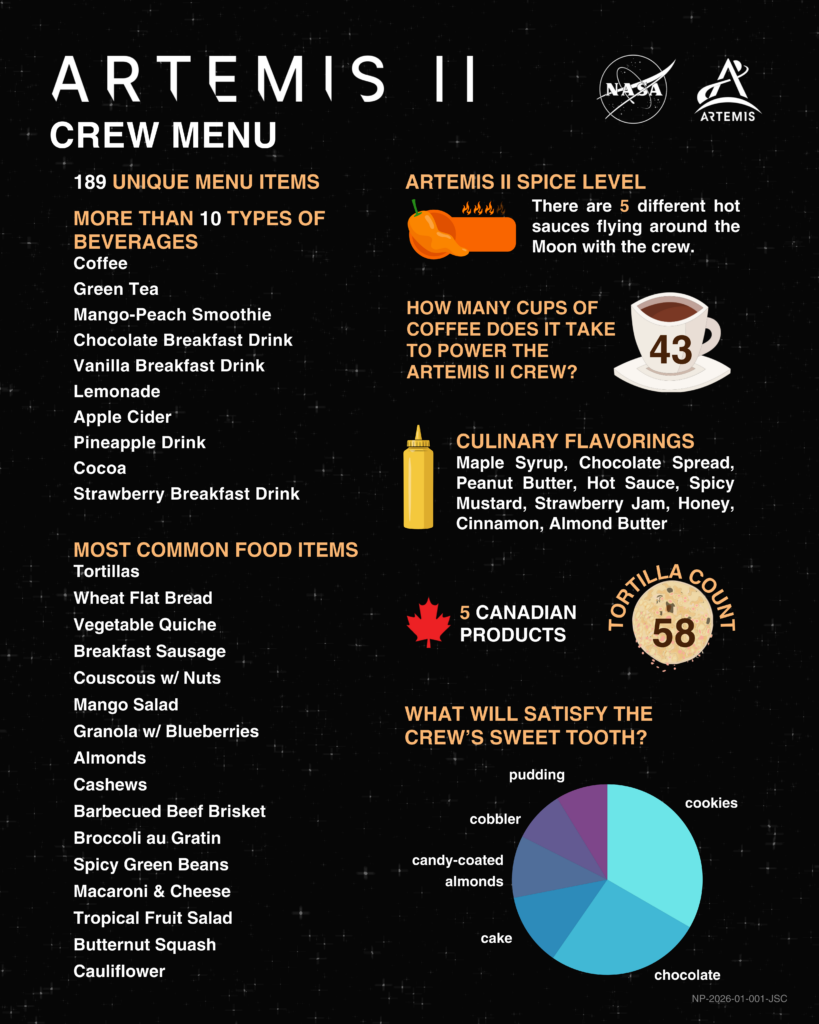
Fueling the Journey: NASA’s Space Menu for Artemis II
Food News!
NASA’s Artemis II mission marks a significant step forward in human space exploration, and a crucial aspect of this journey is the carefully curated food system that will sustain the crew around the Moon. With no resupply missions or refrigeration capabilities aboard the Orion spacecraft, every meal must be designed for safety, stability, and ease of preparation, ensuring astronauts stay healthy and alert during their mission.
Designing Food for Safety and Stability:
The selection and packaging of foods for Artemis II involve meticulous planning. Foods must have a long shelf life, remain safe to eat, and deliver essential nutrients. They are chosen to meet the crew’s caloric and hydration needs while fitting within Orion’s strict mass, volume, and power constraints. The foods are also tailored to be easy to prepare and consume in microgravity, with minimal crumbs or particulates that could interfere with onboard systems or pose health risks. Before finalizing the menu, astronauts provide input by sampling and rating potential meals, ensuring their preferences are incorporated into the final selection.
Daily Meals in Space:
An astronaut’s typical day aboard Artemis II includes scheduled times for breakfast, lunch, and dinner. Each crew member will have access to two flavored beverages daily, which may include coffee, although beverage options are limited by the spacecraft’s weight restrictions. Since Orion lacks refrigeration and late-load capabilities, fresh foods are not part of the menu. Instead, shelf-stable foods—such as dehydrated or thermostabilized items—are used to guarantee safety and quality throughout the mission, while also reducing the risk of crumbs and debris in microgravity.
Evolution of Space Food Systems:
The menus for Artemis II build upon decades of advancements in space nutrition. During Apollo missions, food options were limited and technologically basic. The space shuttle introduced more variety and onboard preparation, and the International Space Station benefits from regular resupply and occasional fresh foods. In contrast, Artemis II’s menu is fixed and pre-selected, designed for a self-contained system with no resupply capability. This evolution ensures astronauts have nutritious, palatable meals tailored to the unique environment of deep space.
Crew Input and Menu Customization:
Crew members are actively involved in selecting their meals. During preflight testing, they sample and evaluate all menu items, providing feedback that helps shape their final meal plans. Their preferences are balanced with nutritional needs and spacecraft constraints. Typically, each astronaut’s menu includes two to three days’ worth of food stored together in a single container, giving flexibility for meal choices during the mission.
Meal Planning for Different Mission Phases:
Menus are customized for each phase of the mission—launch, transit, and re-entry—based on the spacecraft’s operational capabilities. During launch and landing, when Orion’s potable water dispenser is unavailable, astronauts rely on ready-to-eat foods that require no rehydration. Once in transit, the full range of prepared meals becomes available, allowing astronauts to rehydrate or heat their food using onboard equipment like a compact food warmer.
Food Preparation in Space:
All foods aboard Orion are designed to be ready-to-eat, rehydratable, thermostabilized, or irradiated for safety and convenience. The crew uses Orion’s potable water dispenser to rehydrate meals and beverages, and a small, portable food warmer to heat their meals as needed, simplifying the process in microgravity.
Overcoming Challenges of Space Food Systems:
Designing food for Orion involves balancing nutritional value, safety, and crew preferences within the spacecraft’s tight mass, volume, and power limits. Foods must be easy to store, prepare, and eat without generating crumbs or waste that could interfere with systems or crew health. The focus is on simplicity and reliability, ensuring astronauts can maintain proper nutrition and hydration throughout their lunar journey.
As Artemis II prepares to launch, the carefully crafted food system exemplifies NASA’s commitment to crew health and safety, blending technological innovation with practical design to support humanity’s return to the Moon.
 Graphic Courtesy of NASA
SOURCE: NASA